Dialed GG Sound
Dialed GG is a free collection of browser games built around one idea: your senses remember less than you think. Each game isolates a single sense, plays you something to memorize, takes it away, and asks you to recreate it. Your accuracy is scored from 0 to 50.
The first game is a sound memory game. You hear a tone, and after a few seconds of silence you have to find it again by dragging across a frequency range. The second game does the same thing with color. Both are playable on any device with a modern browser, and both are completely free with no account required.
Each round generates a random target, so the experience is different every time you play. You can compare your results against a global leaderboard, share your score, or send a challenge link to a friend who will play the exact same set of tones or colors you did.
Two Games, Two Senses
Dialed GG currently offers two games. One tests your auditory memory and the other tests your visual memory. They share the same scoring scale and challenge system, so you can compare how your ears perform against your eyes.
A sound memory game where you listen to a tone, then drag to match its frequency from memory. Five rounds, each scored from 0 to 10. Also known as a match frequency game or sound guesser among players who enjoy auditory puzzles.
Play SoundA colour matcher game where you see a color, then adjust hue, saturation, and brightness to recreate it. Dialed GG colour matching works with the same five-round structure and the same 0 to 50 scoring system.
Play ColorHow the Sound Memory Game Works
The Dialed GG sound game has five rounds. In each round, the game generates a random frequency somewhere between 80 Hz and 1200 Hz in easy mode, or between 60 Hz and 1400 Hz in hard mode. That tone plays through your speakers or headphones for a few seconds while a waveform animation fills the screen. Then the tone stops.
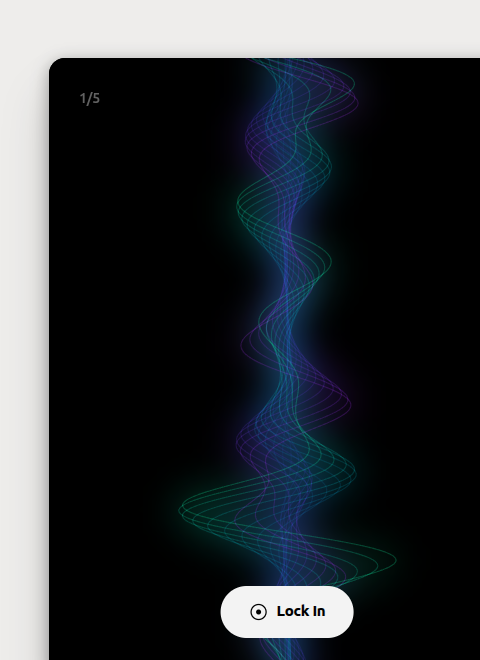
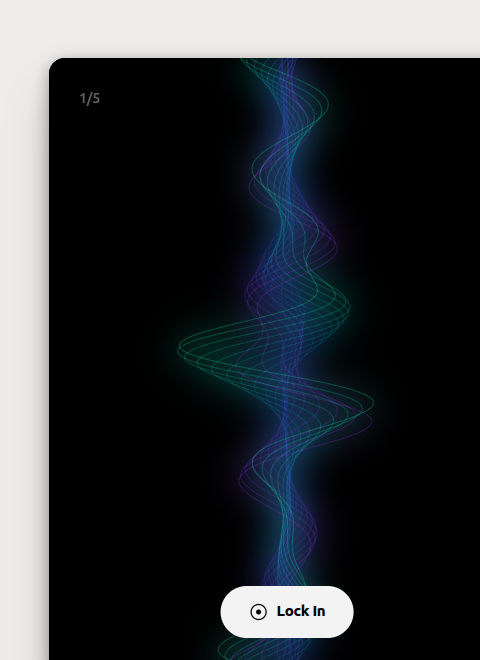
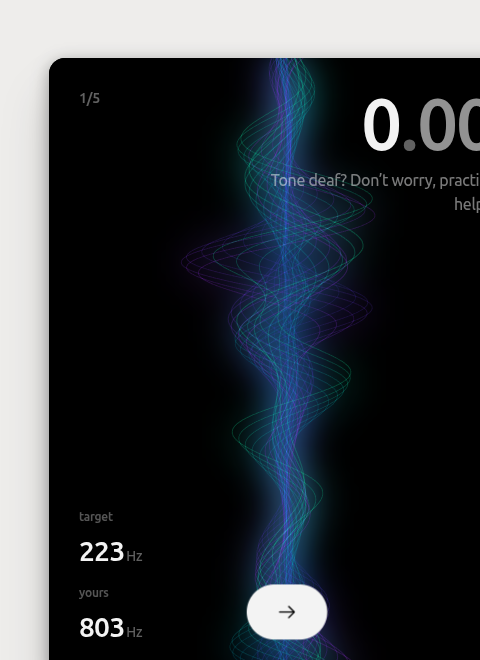
After the tone stops, a timer counts down and you have to press and hold anywhere on screen, then drag up or down to sweep through the frequency range. The tone plays in real time as you drag, so you can compare what you hear with what you remember. When you think you have found the right pitch, release to lock in your answer.
This press-and-hold interaction is intentional. It forces you to commit to a direction rather than casually tapping around. The waveform on screen responds to your input, growing in intensity while you hold and fading when you release. Five rounds later, your total score lands somewhere between 0 and 50.
How Scoring Works on Dialed GG
Every round in both the sound memory game and the colour matcher game is scored from 0.00 to 10.00. A perfect match earns a full 10 points. The further your guess is from the target, the lower your score. After five rounds, your total ranges from 0 to 50.
Sound Scoring — ERB Psychoacoustic Model
Scoring in Dialed GG Sound is based on a psychoacoustic model called ERB, which stands for Equivalent Rectangular Bandwidth. The key idea is that human ears do not perceive pitch on a linear scale. A 10 Hz difference between 100 Hz and 110 Hz sounds like a noticeable change, but the same 10 Hz difference between 3000 Hz and 3010 Hz is nearly impossible to hear. The scoring system accounts for this by converting frequencies into a perceptual scale before measuring distance.
This means low-frequency tones are not unfairly harder than high-frequency tones when you play the match frequency game. A close guess at 100 Hz and a close guess at 1000 Hz will score similarly, as long as the perceptual distance is the same. The model uses two overlapping curves to calculate your score: a steep curve that rewards near-perfect accuracy, and a gentler curve that gives partial credit for being in the right general area.
Color Scoring — Perceptual Distance
The Dialed GG color game uses a similar approach adapted for visual perception. Hue, saturation, and brightness are each compared independently, with different weights reflecting how the human eye distinguishes between color properties. The combined distance determines your final score for each round.
Challenge Your Friends
After you finish a game on Dialed GG, you can generate a challenge link and send it to anyone. When they open the link, they play the exact same set of tones or colors that you did. Their scores are recorded alongside yours, and both of you can see how the other performed on each round.
This works for both the sound guesser game and the colour matcher game. The challenge system generates a unique code for each game session, so every link contains a specific sequence of targets. Your friend does not need to create an account or install anything. They open the link in their browser and start playing immediately.
Scores from challenge games appear on the same global leaderboard as solo games. If you want to see how you rank overall, the leaderboard shows the top results for both easy and hard mode. The ranking updates after every game, so you can revisit the page to track your position over time.
Why Sensory Memory Games Are Harder Than You Expect
Most people feel confident about their ability to remember what they just heard or saw. A tone plays for three seconds, then you have to find it again. It sounds simple. In practice, players using Dialed GG Sound average around 28 out of 50 on their first attempt. The Dialed GG Color game tends to produce slightly higher averages, around 32 out of 50, but the spread is wide and most players are surprised by how difficult it actually is.
The difficulty comes from how sensory memory works. When you hear a tone, the raw auditory information stays in your short-term memory for roughly three to four seconds. Researchers call this echoic memory. It decays quickly and is easily disrupted by new sounds or internal thoughts. By the time you start dragging to find the frequency in the sound memory game, the precise pitch has already started to blur.
Visual memory, called iconic memory, behaves differently. The initial snapshot is more detailed but fades even faster, usually within one second. However, color attributes like hue tend to persist longer in working memory than exact pitch does. This is one reason the colour matcher game on Dialed GG colour tends to produce higher scores than the sound guesser for most players.
What makes these games interesting from a cognitive standpoint is that they isolate a single dimension. You are not remembering a song or a painting. You are trying to hold one frequency or one specific color in your mind and reproduce it with precision. That narrow focus removes the contextual cues that normally help memory work, and it exposes just how approximate our sensory recall actually is.
Players who practice regularly do get better. Research on auditory training suggests that repeated exposure to pitch-matching tasks improves discrimination thresholds over time. The same holds for color matching. Your first game on Dialed GG is likely your worst, and improvement tends to follow a predictable curve across your first dozen or so sessions.
Common Questions About Dialed GG
Is Dialed GG free to play?
Yes. Both the sound memory game and the Dialed GG color game are completely free. There are no ads, no paywalls, and no premium tiers. You open the page and start playing.
Do I need to download an app?
No. Dialed GG runs entirely in your web browser. It works on Chrome, Safari, Firefox, and Edge on both desktop and mobile. No installation is required.
Can I play on my phone?
Yes. The interface is designed for touch input. In the sound guesser, you press and hold on the screen, then drag up or down to change the frequency. In the colour matcher game, you use sliders to adjust hue, saturation, and brightness. Both work well on phones and tablets.
Do I need headphones for the sound game?
Headphones are recommended for the match frequency game because they let you hear the tone more clearly, especially at low frequencies. Phone speakers often distort frequencies below 200 Hz, which can make it harder to match them accurately.
How is my score calculated?
Each round is scored from 0 to 10 based on how close your guess is to the target. The Dialed GG Sound game uses an ERB-based psychoacoustic model so that accuracy is measured in perceptual terms, accounting for how humans actually hear pitch. The Dialed GG colour game uses a weighted distance model across hue, saturation, and brightness channels.
Can I challenge someone else?
Yes. After completing a game, you can copy a challenge link. Anyone who opens that link will play the exact same sequence of tones or colors. Their score is compared to yours and both results appear on the leaderboard.
What is easy mode vs hard mode?
Easy mode in Dialed GG Sound uses a frequency range from 80 Hz to 1200 Hz. Hard mode expands that range to 60 Hz through 1400 Hz, making the match frequency game more demanding. The Dialed GG color game similarly adjusts the difficulty of target colors between modes.